




June 12 and Many Unanswered Questions
By Femi Ogundele
On the morning of June 12, a cool Abuja breeze drifted over Eagle Square as dignitaries, lawmakers, and ordinary Nigerians gathered in quiet anticipation. It was Democracy Day not just a holiday, but a reflection on Nigeria’s democratic journey. At the center of it all was President Bola Ahmed Tinubu, addressing a joint session of the National Assembly to mark 26 years of uninterrupted civilian rule.
Yet beneath the orchestrated fanfare, a question lingered: What does democracy truly mean to a nation still battling hunger, inflation, and insecurity?
Senate President Godswill Akpabio was quick to praise Tinubu’s leadership, calling him “one of the architects of Nigeria’s democracy.” Akpabio lauded the administration’s bold policies, listing reforms, loans, and new laws. Yet outside the walls of the assembly, that praise clashed with the lived reality of citizens facing daily frustrations with rising living costs and decaying infrastructure.
President Tinubu, once a pro-democracy activist, reflected on Nigeria’s turbulent journey, paying tribute to the heroes of June 12, 1993, especially Moshood Kashimawo Abiola, whose stolen mandate inspired the day’s significance. “we must not forget the long list of those who equally deserve to be called heroes of Nigerian democracy,” he said
To deepen that tribute, Tinubu announced national honours for key figures of the June 12 struggle, including posthumous awards for fallen heroes who paid the ultimate price in Nigeria’s fight for democratic freedom.
Tinubu’s Democracy Day speech echoed his pro-democracy past, but that legacy now sits beside a nation battling economic hardship. Fuel subsidies are gone, tariffs are up, and the naira unstable. Still, Tinubu painted a hopeful picture. “Upon assuming office, my team and I moved to reform our ailing economy… We are already seeing results. Inflation is easing… and the Naira exchange rate has stabilised,” he said. Yet for many Nigerians, that hope feels distant beneath the weight of daily struggles.
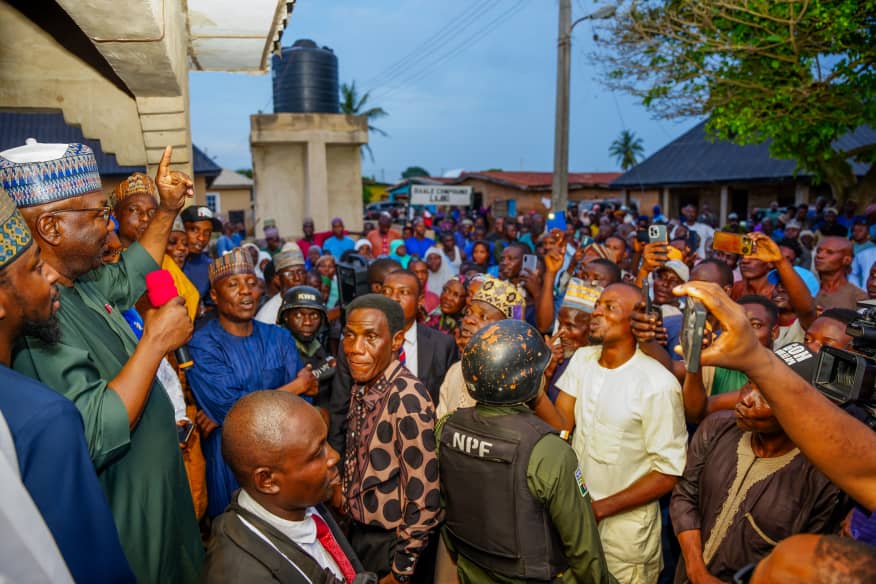
For activists like Deji Adeyanju, Democracy Day isn’t just about parades and speeches, it’s about unfinished business. In Lagos and Abuja, pockets of protesters carried banners: “Reverse electricity tariff hike now,” “End hunger,” and “Make democracy real.” Police trucks lined the streets, an ironic picture on a day meant to celebrate freedom. “What is democracy if the people can’t eat?” one protester in Lagos asked, holding a loaf of bread high as a symbol of rising food prices.
Despite the protests, the federal government ensured that the day remained largely peaceful. From Ondo to Kaduna, security operatives were stationed at strategic points. The Nigerian Security and Civil Defence Corps (NSCDC) and state police commands coordinated efforts to maintain calm, knowing that today’s celebration could easily be marred by public anger.
But not all voices were raised in protest. Minister of Women Affairs, Imaan Sulaiman-Ibrahim, used the occasion to highlight the progress made for women and children. “Our democracy must be inclusive,” she said. Plans are underway to rename her ministry to better reflect its broadened mandate, with specific programs targeted at supporting vulnerable groups. In her words, democracy is hollow if women and children are left behind.
Across the nation, governors and traditional leaders called for peace and unity. Kogi State Governor Ahmed Ododo described the day as “a solemn reminder that democracy is not gifted, it is earned.” On radio and television, Democracy Day-themed discussions flooded the airwaves, many featuring students and market women alongside political analysts all trying to define what democracy means for them.
For some, democracy is about elections. For others, it’s about the price of rice. And for a growing number of citizens, it’s about the ability to question their leaders without fear. June 12 isn’t just history, it’s a mirror reflecting Nigeria’s achievements and its unfinished dreams.